 by
Buying an SUV is a major financial decision. While the purchase price is important, the real cost of ownership goes far beyond what you pay at the dealership. Maintenance, unexpected repairs, fuel consumption, insurance premiums and depreciation can all affect how much money you spend over the years.
Some SUVs are known for their ability to accumulate high mileage while requiring relatively modest routine maintenance. Others may look attractive when new but become expensive to own as they age.
The good news is that buyers have several options when looking for an SUV that offers a combination of durability, practicality and long-term value. Certain models have developed strong reputations for dependable engines, comfortable interiors, reasonable maintenance requirements and good resale values.
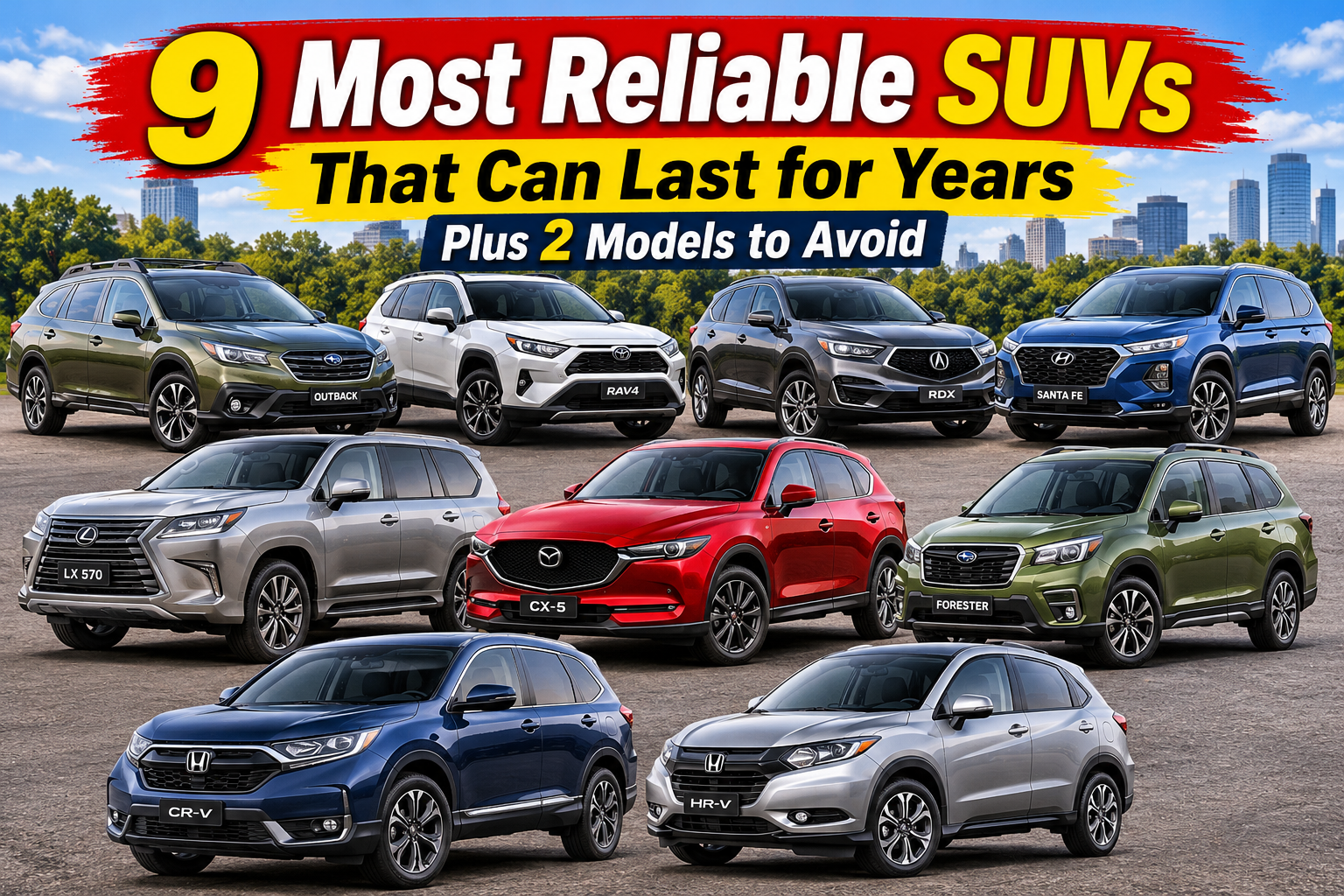
In this guide, we explore nine SUVs highlighted for their long-term ownership potential, from practical compact crossovers to premium luxury models. We will also look at two SUVs that the original discussion identifies as potential financial risks for buyers.
Whether you are shopping for a used SUV or planning to keep your next vehicle for 10 years or longer, these models are worth understanding.
1. Subaru Outback – A Practical SUV Alternative With Standard AWD
The Subaru Outback has built a loyal following among drivers who want everyday comfort combined with all-weather capability. Although its design has traditionally been closer to a raised wagon than a conventional SUV, its practical interior, ground clearance and standard all-wheel-drive system make it an appealing choice for families and outdoor enthusiasts.
One of the Outback’s biggest advantages is its ability to handle different driving conditions. It is suitable for regular commuting, highway journeys, snowy roads and light dirt trails.
The transcript highlights that many well-maintained Outbacks can exceed 200,000 miles, with some reaching approximately 300,000 miles. These figures are examples of potential longevity rather than guaranteed results.
Why consider the Subaru Outback?
- Standard all-wheel drive: Provides additional traction and stability in challenging weather conditions.
- Practical design: Offers useful cargo space and comfortable seating for everyday family use.
- Long-term potential: Properly maintained examples can accumulate substantial mileage.
- Safety reputation: The Outback has received strong safety recognition in certain model years.
- Used-market appeal: The 2020 model year is highlighted in the transcript as a potentially attractive balance of modern technology and used-car value.
The transcript also discusses the naturally aspirated 2.5-liter boxer engine and a turbocharged engine option. Engine availability and specifications vary by model year and market.
Potential drawbacks
The standard 2.5-liter engine is not particularly performance-focused, while turbocharged versions may involve different running costs. Buyers should also inspect the vehicle’s maintenance records and all-wheel-drive system before purchasing.
Best for: Families and drivers who want a practical vehicle with standard AWD and everyday versatility.
2. Toyota RAV4 – A Popular SUV With Strong Resale Value
The Toyota RAV4 is one of the most recognizable compact SUVs in the market. Its popularity comes from a straightforward formula: practical dimensions, easy driving characteristics, efficient engines and a reputation for dependable ownership.
The transcript points out that older RAV4 models have demonstrated impressive longevity, with some examples reaching 300,000 miles. It also highlights the vehicle’s ability to retain its value compared with many competing SUVs.
For used-car buyers, resale value can make a significant difference. A vehicle that holds its value well may cost more initially, but it can return a larger portion of the purchase price when it is eventually sold.
What makes the Toyota RAV4 attractive?
- Established reliability reputation: Toyota’s engineering and the RAV4’s ownership history make it a popular choice.
- Good resale value: Strong demand can help protect owners against depreciation.
- Everyday practicality: Its compact size makes city driving and parking relatively convenient.
- Reasonable performance: Four-cylinder engines prioritize efficiency and everyday usability.
- Family-friendly design: The RAV4 offers a useful combination of passenger space and cargo capacity.
The transcript specifically mentions the 2.5-liter four-cylinder engine found in newer models, describing it as dependable but not especially exciting to drive.
Potential drawbacks
Buyers who prioritize acceleration or sporty driving may find the RAV4’s performance ordinary. Its strong resale reputation can also mean that used examples are relatively expensive.
Best for: Buyers who prioritize reliability, practicality and long-term resale value.
3. Acura RDX – Luxury Comfort Without Some Luxury Ownership Costs
The Acura RDX is an interesting alternative for buyers who want a premium SUV but do not necessarily want the maintenance expenses associated with some European luxury brands.
The transcript particularly highlights the 2013–2018 generation. During this period, the RDX shared important powertrain components with the Honda Pilot, including a 3.5-liter V6 engine and a six-speed automatic transmission.
This connection to Honda’s mainstream engineering is presented as one of the reasons the RDX can offer a more approachable ownership experience than some luxury competitors.
Why the Acura RDX deserves attention
- Powerful V6 engine: The 3.5-liter engine offers stronger performance than many basic compact SUVs.
- Premium interior: Leather seating, improved sound insulation and additional comfort features create a more luxurious experience.
- Honda-related engineering: Shared powertrain components provide a familiar mechanical foundation.
- Used-market value: Older RDX models can offer premium features at prices that may be competitive with mainstream SUVs.
- Long-term ownership potential: The transcript reports that many owners reach approximately 150,000 miles with routine maintenance.
Potential drawbacks
The RDX is still a luxury vehicle, so certain replacement parts, specialized repairs and insurance costs may be higher than those of a basic economy SUV. A used example should be inspected carefully, particularly for service history and transmission condition.
Best for: Buyers who want a comfortable luxury SUV without automatically choosing a more expensive European alternative.
4. Hyundai Santa Fe – A Family SUV With Warranty Appeal
The Hyundai Santa Fe has developed a strong position in the midsize SUV segment by offering practical space, useful features and competitive pricing.
The transcript emphasizes Hyundai’s warranty coverage as one of the model’s major selling points. It refers to a 10-year/100,000-mile powertrain warranty, although buyers should understand that warranty eligibility, coverage and transferability depend on the vehicle, market and ownership circumstances.
For a new-car buyer, a strong factory warranty can reduce the financial risk associated with unexpected mechanical problems. However, used-car shoppers should never assume that the original warranty automatically transfers in full to a second owner.
Reasons to consider the Hyundai Santa Fe
- Family-friendly space: The Santa Fe is designed to accommodate everyday family transportation.
- Warranty support: Eligible buyers may benefit from substantial original powertrain coverage.
- Practical running costs: The transcript highlights fuel economy and insurance affordability as potential advantages.
- Comfortable everyday driving: It offers a useful balance of convenience and practicality.
- Long-term potential: Some owners report reaching more than 200,000 miles with regular servicing.
Potential drawbacks
Reliability can vary considerably between generations, engines and model years. Before buying a used Santa Fe, check for outstanding recalls, engine-related service history and evidence of regular maintenance.
Best for: Families looking for a practical midsize SUV with competitive features and potentially useful warranty protection.
5. Lexus LX – Luxury SUV Durability With Land Cruiser Roots
The Lexus LX is one of the most interesting choices on this list because it combines premium comfort with the rugged engineering associated with the Toyota Land Cruiser.
The transcript describes the LX as a luxury version of the Land Cruiser, highlighting its reputation for durability and its ability to handle demanding driving conditions.
Some examples have reportedly accumulated extremely high mileage, with the discussion mentioning 400,000–500,000 miles and even higher figures in certain markets. These exceptional examples demonstrate the platform’s potential, but they should not be interpreted as typical or guaranteed outcomes.
Why the Lexus LX stands out
- Land Cruiser heritage: It shares important engineering foundations with a vehicle known for off-road durability.
- Premium comfort: The cabin offers a more luxurious experience than many traditional off-road SUVs.
- Strong reputation: The LX has a loyal following among buyers who value long-term ownership.
- Resale strength: Well-maintained examples can retain substantial market value.
- Heavy-duty character: Its construction and capability make it suitable for demanding conditions.
Potential drawbacks
Fuel consumption is an important consideration. The transcript estimates approximately 15–17 miles per gallon for the vehicles being discussed, although actual economy varies by generation, engine, driving conditions and market.
Older luxury SUVs can also require expensive repairs involving suspension components, electronics and specialized equipment.
Best for: Buyers who want a premium, capable SUV and are prepared for higher fuel and ownership costs.
6. Mazda CX-5 – A Reliable Compact SUV That Is Enjoyable to Drive
The Mazda CX-5 offers a slightly different approach to the compact SUV market. Rather than focusing only on practicality, Mazda has emphasized driving enjoyment, attractive styling and a more premium-feeling interior.
The transcript highlights the CX-5’s conventional six-speed automatic transmission as an advantage compared with competitors that use continuously variable transmissions (CVTs).
It also mentions a 4.5-out-of-5 reliability rating attributed to RepairPal. Ratings can change over time and may vary by model year or data source, so buyers should check current information before making a purchase decision.
What makes the Mazda CX-5 appealing?
- Engaging driving experience: Its handling and steering feel more responsive than those of many ordinary compact SUVs.
- Conventional automatic transmission: The six-speed automatic provides a different ownership proposition from a CVT-equipped vehicle.
- Premium interior feel: The cabin design and materials give the CX-5 an upscale character.
- Strong ownership reputation: The transcript highlights the possibility of exceeding 200,000 miles with proper maintenance.
- Resale value: The model can offer competitive value in the used market.
Potential drawbacks
Rear-seat and cargo space may feel more limited than in some rivals, including the Toyota RAV4 and Honda CR-V. Buyers who need maximum interior room should compare these vehicles in person.
Best for: Drivers who want a compact SUV that combines practical ownership with enjoyable handling and attractive styling.
7. Subaru Forester – A Practical SUV for All-Weather Driving
The Subaru Forester is known for its upright design, useful visibility and standard all-wheel-drive capability. It is a practical choice for people who regularly encounter rain, snow or uneven roads.
The transcript refers to an exceptionally high Consumer Reports reliability score of 98 out of 100. Since reliability scores depend on the specific model year and survey, this figure should be independently checked before publication or used to evaluate a particular vehicle.
One important topic raised in the discussion is Subaru’s continuously variable transmission.
Why consider the Subaru Forester?
- Standard AWD: Provides useful traction in different weather conditions.
- Practical cabin: Its design offers good visibility and everyday usability.
- Fuel efficiency: It can provide competitive fuel economy for an all-wheel-drive compact SUV.
- Long-term ownership potential: The transcript notes that many owners report exceeding 200,000 miles.
- Resale demand: Subaru’s loyal customer base can support used-market values.
Important CVT maintenance consideration
The transcript recommends changing CVT fluid every 30,000 miles to help maintain transmission performance.
However, service intervals are not identical across every Forester generation. Owners should follow the maintenance schedule specified for their exact vehicle, including any severe-driving recommendations, rather than assuming one interval applies universally.
Potential drawbacks
Transmission maintenance and repair history deserve particular attention when buying a used Forester. Buyers should also check the engine, cooling system, suspension and AWD components.
Best for: Drivers who need an all-weather compact SUV with practical space and standard AWD.
8. Honda CR-V – A Dependable Choice for Families
The Honda CR-V has remained a major competitor in the compact SUV market because it delivers a useful combination of comfort, efficiency, practicality and everyday reliability.
The transcript highlights the impressive mileage achieved by some older second-generation CR-V models, including examples approaching 500,000 miles. Such vehicles are exceptional cases, but they help explain why the CR-V has earned a strong reputation among long-term owners.
Another important advantage is its practical design. The CR-V is suitable for commuting, family transportation and longer journeys without being unnecessarily large.
Why the Honda CR-V is worth considering
- Established reliability reputation: Honda’s engineering has helped make the CR-V a popular long-term ownership choice.
- Practical interior: It offers useful passenger and cargo space.
- Fuel efficiency: The transcript highlights fuel economy as one of the CR-V’s advantages.
- Safety features: Certain model years have received strong safety recognition.
- Resale value: Consistent demand can help protect its value in the used market.
The discussion also mentions combined fuel economy of up to approximately 30 miles per gallon for the CR-V being described. Actual figures vary by generation, engine, drivetrain and testing standard.
Potential drawbacks
The CR-V’s popularity can make well-maintained used examples expensive. Buyers should compare the asking price with the vehicle’s mileage, service history and overall condition.
Best for: Families and commuters looking for a practical, efficient SUV with strong long-term ownership appeal.
9. Honda HR-V – A Small SUV With Budget-Friendly Ownership Potential
The Honda HR-V takes the final position in the transcript’s countdown, but its smaller size does not mean it should be overlooked.
Designed for urban driving and everyday practicality, the HR-V offers a more compact alternative to the CR-V. Its smaller dimensions can make parking and navigating busy streets easier, while its efficient engines help reduce fuel expenses.
The transcript reports that owners commonly achieve approximately 150,000–200,000 miles, with relatively few major repairs when the vehicle is properly maintained.
Why the Honda HR-V makes sense
- Compact dimensions: Convenient for city driving and parking.
- Fuel efficiency: Smaller engines can help reduce fuel consumption.
- Everyday practicality: It offers useful interior flexibility for a compact vehicle.
- Lower ownership expenses: Its size and mainstream positioning can make it an economical daily driver.
- Resale value: Honda’s reputation can support demand in the used-car market.
The transcript mentions highway fuel economy of up to approximately 34 miles per gallon. This is not a figure that applies to every HR-V; it depends on model year, engine, drivetrain and testing conditions.
Potential drawbacks
The HR-V cannot match the engine power, towing capability or interior space of larger SUVs. It is better suited to daily transportation than demanding off-road driving or heavy-duty family use.
Best for: City drivers, small families and buyers who prioritize fuel efficiency and manageable ownership costs.
2 SUVs to Think Twice About Before Buying
Not every popular SUV is automatically a good long-term investment. The transcript also highlights two models that may expose owners to expensive repairs, particularly when the wrong model year or a poorly maintained example is purchased.
These warnings should be treated as reasons for careful research rather than proof that every vehicle from these model lines is unreliable.
1. Jeep Wrangler – Iconic Off-Road Ability, But Potentially Expensive Ownership
The Jeep Wrangler is one of the most recognizable off-road vehicles ever produced. Its rugged appearance, removable roof and doors, four-wheel-drive capability and aftermarket customization options have made it extremely popular.
However, the transcript raises concerns about the potential ownership costs of certain Wrangler models.
Reported issues include:
- Electrical problems: Some owners have experienced electrical faults that can be difficult to diagnose.
- Oil leaks: Engine-related leaks may require repairs as vehicles age.
- Suspension concerns: Worn or damaged suspension components can affect ride quality and handling.
- Death wobble: This term describes severe front-end shaking that can occur under certain conditions, often involving steering or suspension wear.
- Insurance expenses: Premiums can vary depending on the vehicle, driver, location and insurer.
The Wrangler’s off-road capability is a major attraction, but it is important to recognize that rugged capability does not automatically mean low maintenance costs.
Before purchasing one, inspect the steering system, suspension, drivetrain and electrical components. A professional pre-purchase inspection is especially valuable if the vehicle has been modified or used extensively off-road.
Buyer advice: Choose a Wrangler because you genuinely need or enjoy its off-road capabilities, not because you assume it will always be inexpensive to own.
2. Ford Explorer – Pay Attention to Model Year and Transmission History
The Ford Explorer has a long history as a family-friendly SUV, offering comfortable seating, useful cargo space and a range of engine and technology options.
However, the transcript particularly warns about certain 2010s models, highlighting reported transmission failures and other mechanical concerns.
Issues mentioned include:
- Transmission problems: Reported symptoms include rough shifting, hesitation and premature failure.
- Water pump leaks: Certain engine configurations can involve expensive water pump repairs.
- Electrical glitches: Electronic faults may affect convenience and vehicle operation.
- Repair expenses: Major transmission repairs or replacement can create substantial bills.
- Recall history: Buyers should check whether all applicable safety recalls have been completed.
The transcript estimates that some major transmission repairs can cost $3,000 or more. Actual repair prices depend on the model year, location, parts availability and labor rates.
It is important not to treat every Ford Explorer as equally problematic. Different generations and engine configurations have different reliability histories.
Buyer advice: Research the exact model year and engine, review the transmission service history and obtain an independent mechanical inspection before purchasing.
How to Choose an SUV That Will Save Money Over the Long Term
Choosing a dependable SUV involves more than comparing brand names or reading reliability rankings. A vehicle’s overall condition, maintenance history and suitability for your driving habits can make a much bigger difference than its reputation alone.
Here are several important points to consider before buying.
1. Check the Complete Maintenance History
A vehicle with documented oil changes, fluid replacements and scheduled servicing is generally a more reassuring purchase than one with an unknown history.
Look for maintenance records covering:
- Engine oil and filter changes.
- Transmission fluid servicing.
- Cooling system maintenance.
- Brake fluid and brake component replacement.
- Differential and AWD system servicing, where applicable.
- Suspension and steering repairs.
2. Research the Exact Model Year
Reliability can change significantly between generations and even between individual model years.
Do not assume that every vehicle from a reliable brand has the same mechanical strengths. Research the engine, transmission and known issues associated with the exact vehicle you are considering.
3. Compare Total Ownership Costs
A low purchase price does not necessarily mean a cheap SUV to own.
Consider the combined cost of:
- Fuel.
- Insurance.
- Regular servicing.
- Replacement tires.
- Unexpected mechanical repairs.
- Taxes and registration.
- Depreciation.
A more expensive SUV with a strong service history may sometimes be a better financial decision than a cheaper vehicle requiring immediate repairs.
4. Get a Professional Pre-Purchase Inspection
Before buying a used SUV, arrange an independent inspection by a qualified mechanic.
The inspection should cover the engine, transmission, suspension, brakes, tires, electrical systems, underbody and signs of accident damage.
For four-wheel-drive and all-wheel-drive vehicles, check that the relevant drivetrain systems operate correctly.
5. Verify Warranty Coverage
An extended warranty is not automatically a good investment.
Before paying for additional coverage, compare the warranty price with the vehicle’s reliability history, age, mileage, repair costs and existing manufacturer coverage.
Read the contract carefully. Pay particular attention to exclusions, deductibles, coverage limits, approved repair facilities and whether important components are actually included.
An extended warranty may provide useful protection for some buyers, but it can be poor value if the coverage is limited or the vehicle is already relatively dependable.
Quick Comparison: All 9 SUVs
| SUV | Main advantage | Important consideration |
|---|---|---|
| Subaru Outback | Standard AWD and practicality | Check drivetrain and service history |
| Toyota RAV4 | Reliability reputation and resale value | Used prices can be high |
| Acura RDX | Luxury comfort with Honda-related engineering | Luxury repair and parts costs |
| Hyundai Santa Fe | Family practicality and warranty appeal | Check exact engine and model year |
| Lexus LX | Land Cruiser-based durability | Fuel consumption and luxury repairs |
| Mazda CX-5 | Driving experience and conventional automatic | Smaller cabin than some competitors |
| Subaru Forester | Standard AWD and visibility | Verify CVT servicing |
| Honda CR-V | Practicality and long-term ownership reputation | Strong resale can increase purchase prices |
| Honda HR-V | Compact size and fuel efficiency | Less power and space |
Final Verdict: Which SUV Is the Best Long-Term Buy?
There is no single SUV that is perfect for every driver. The right choice depends on your budget, driving conditions, passenger requirements and expectations for long-term ownership.
However, the nine models discussed here offer different advantages for buyers who want to avoid unnecessary ownership expenses.
- Best for resale value: Toyota RAV4.
- Best for practical family transportation: Honda CR-V.
- Best for compact city driving: Honda HR-V.
- Best for all-weather capability: Subaru Outback or Subaru Forester.
- Best for luxury and durability: Lexus LX.
- Best for affordable luxury: Acura RDX.
- Best for driving enjoyment: Mazda CX-5.
- Best for warranty appeal: Hyundai Santa Fe.
The two models highlighted for extra caution are the Jeep Wrangler and Ford Explorer, particularly when considering examples with questionable maintenance histories or model-specific mechanical concerns.
Ultimately, the smartest SUV purchase is not necessarily the newest, cheapest or most powerful vehicle. It is the one that matches your needs, has been properly maintained and can deliver dependable service without creating unnecessary financial pressure.
Summary
A reliable SUV can provide years of useful transportation while helping owners manage repair bills, fuel expenses and depreciation. Models such as the Toyota RAV4, Honda CR-V, Honda HR-V, Subaru Outback and Lexus LX have developed strong reputations for long-term ownership potential.
The Acura RDX, Hyundai Santa Fe, Mazda CX-5 and Subaru Forester also deserve consideration for buyers with different priorities.
However, no SUV is completely maintenance-free. Even vehicles known for durability need regular servicing, and high-mileage examples require careful inspection.
Before making a final decision, research the exact model year, compare ownership costs, verify service records and arrange a professional inspection.
Buy based on condition and evidence, not just reputation. That is one of the best ways to choose an SUV you can confidently keep for many years.