 by
Getting into off-roading and overlanding does not necessarily require spending a fortune on a brand-new SUV or pickup truck. While modern adventure vehicles can carry impressive price tags, the used vehicle market offers plenty of capable alternatives for people who want to explore challenging trails without exhausting their savings.
For beginners, purchasing an affordable used 4×4 can be an especially smart decision. Off-road driving often involves mud, rocks, scratches, and demanding conditions. Starting with a reasonably priced vehicle leaves more money available for essential upgrades such as tires, suspension components, recovery equipment, and protective accessories.
Fortunately, several older SUVs and pickup trucks have developed strong reputations among off-road enthusiasts because of their mechanical capability, aftermarket support, and practical designs.
From the legendary Toyota 4Runner and Tacoma to the surprisingly affordable Lexus GX 470 and Mitsubishi Montero, there are numerous vehicles worth considering.
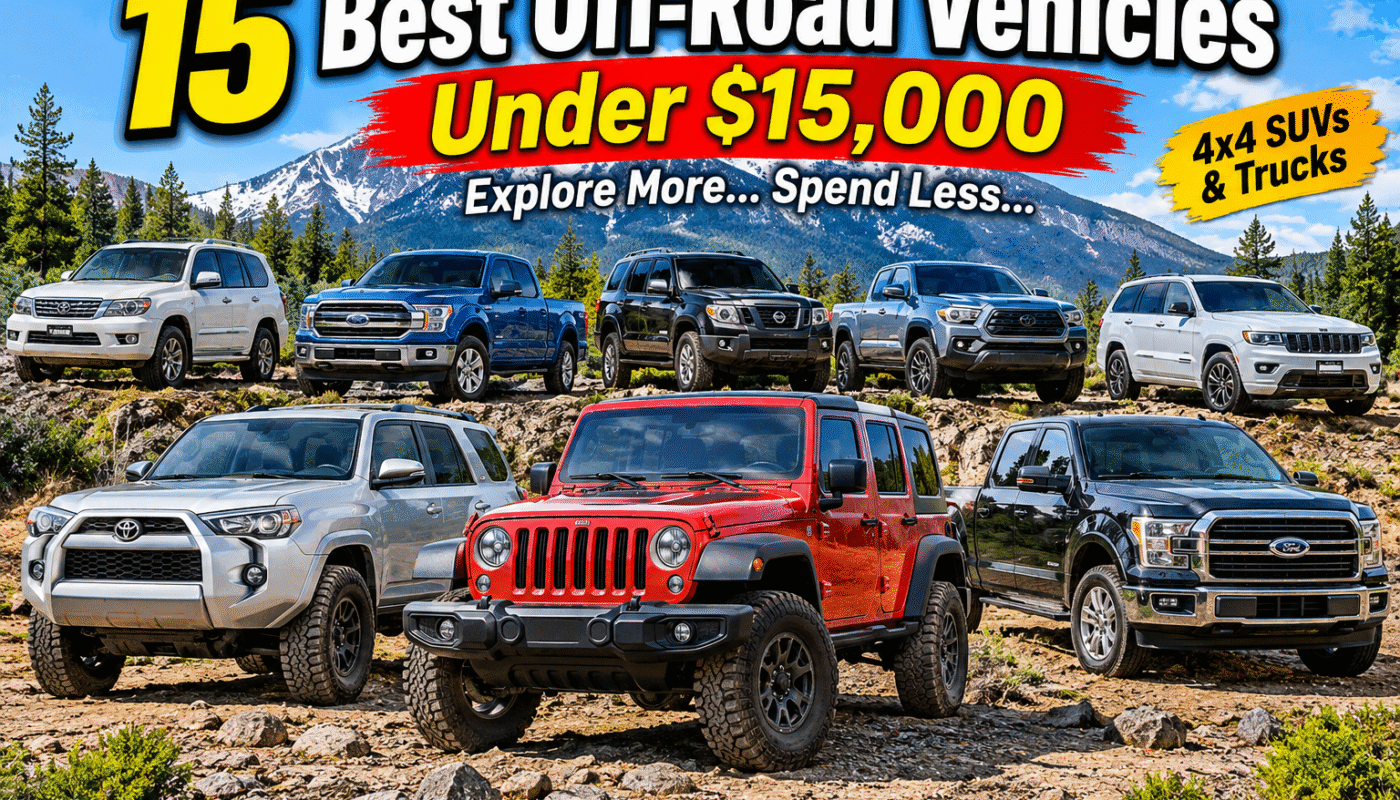
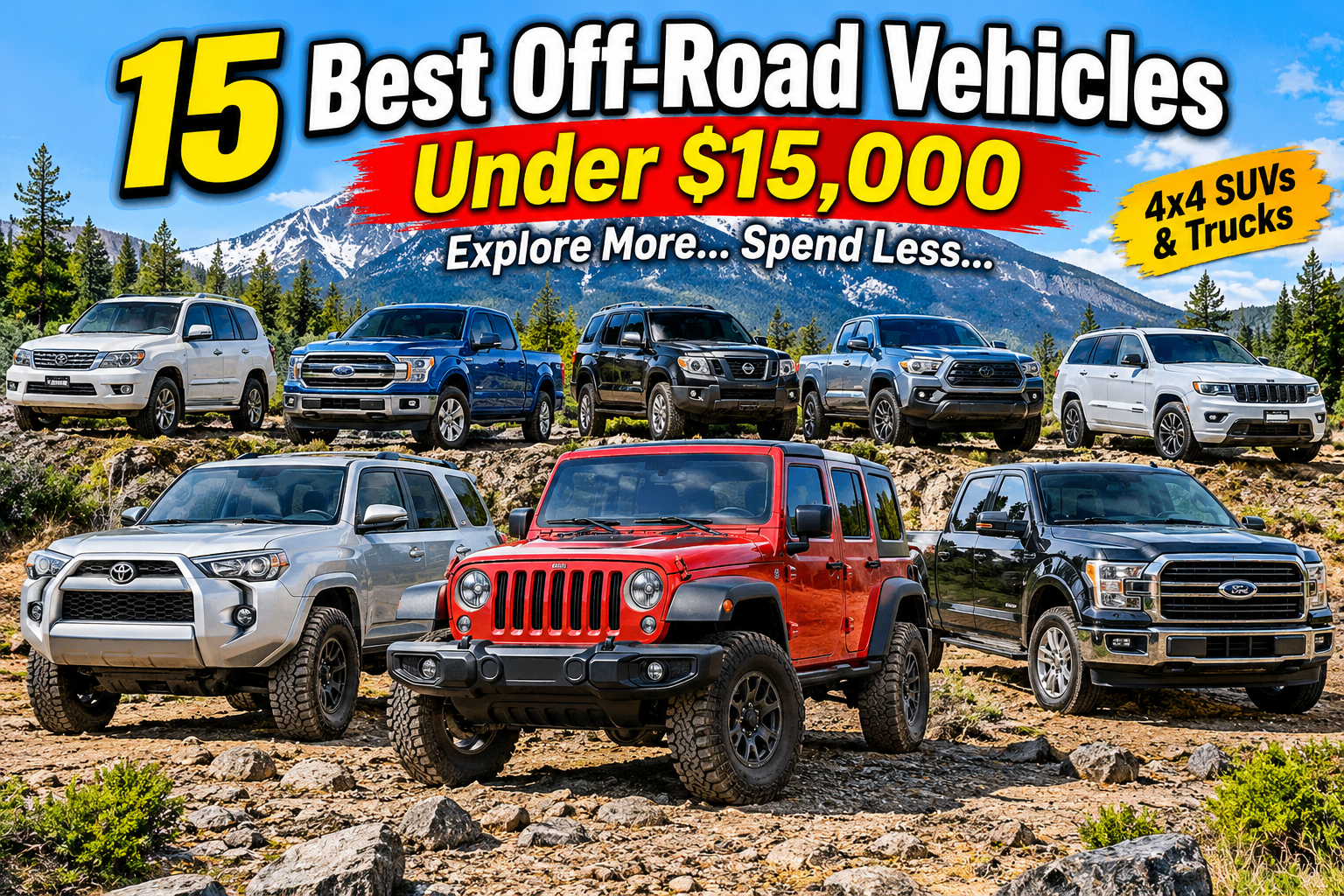
In this guide, we explore 15 used off-road vehicles highlighted as potential choices for a budget of under $15,000. Whether you are interested in weekend trail adventures, long-distance overlanding, or building your first serious 4×4 project, these vehicles offer several interesting starting points.
1. Toyota 4Runner – Third and Fourth Generation
The Toyota 4Runner is one of the most recognizable names in the midsize SUV category. Its combination of durability, practical dimensions, and off-road capability makes it an appealing option for people entering the world of 4×4 adventures.
Two generations are particularly worth considering when shopping within a limited budget.
Third Generation (1995–2002)
The third-generation 4Runner is an attractive choice for buyers looking to keep their initial spending low.
One important feature appeared in the 2001 model year, when Toyota offered a rear electronic locking differential on certain configurations. This feature can provide additional traction when driving through difficult terrain.
Many examples of this generation were highlighted as potential purchases below $10,000, making them particularly interesting for budget-conscious buyers.
Fourth Generation (2002–2009)
The fourth-generation 4Runner provides a more modern alternative while remaining within the original transcript’s $15,000 budget in many cases.
One of its biggest attractions is the availability of V8-powered models, something that distinguishes this generation from the fifth-generation 4Runner.
Buyers should also pay attention to the drivetrain. The 4Runner PreRunner is a two-wheel-drive version, so anyone specifically looking for a 4×4 should verify the vehicle’s configuration before purchasing.
TRD-badged models are also worth investigating because Toyota Racing Development equipment can offer additional off-road-oriented features, depending on the particular model.
Key Advantages:
- Strong reputation for durability.
- Good aftermarket support.
- Available rear electronic locking differential on certain third-generation models.
- V8 engine availability in the fourth generation.
- Practical midsize SUV dimensions.
Potential Disadvantages:
- Desirable examples can command higher prices.
- Older vehicles may require mechanical repairs.
- Two-wheel-drive versions are unsuitable for buyers specifically seeking 4×4 capability.
Best For: Beginners and experienced enthusiasts looking for a dependable midsize off-road SUV.
2. Toyota Tacoma – First Generation and Early Second Generation
The Toyota Tacoma is essentially the pickup truck alternative for people who appreciate the capabilities of the 4Runner.
Its midsize dimensions make it relatively nimble on trails, while its pickup bed provides additional flexibility for transporting camping equipment, recovery gear, and other outdoor essentials.
First Generation (1995–2004)
The first-generation Tacoma is particularly attractive for budget-conscious off-road enthusiasts.
Its reputation for reliability, strong resale value, and extensive aftermarket support has helped maintain demand for older examples.
The transcript highlights that some 20-year-old Tacomas can still command prices between approximately $10,000 and $15,000, reflecting the platform’s popularity.
Second Generation (2005–2015)
Some early second-generation models may also be available within the original budget, although prices become more challenging as buyers look for newer or lower-mileage examples.
TRD-equipped versions are worth considering because they may offer useful off-road-oriented equipment.
Key Advantages:
- Excellent reputation for reliability.
- Strong resale value.
- Extensive aftermarket support.
- Nimble midsize pickup dimensions.
- Practical cargo bed for overlanding equipment.
Potential Disadvantages:
- High demand can make used examples expensive.
- Second-generation models may exceed the budget.
- Low-mileage examples often carry a premium.
Best For: Buyers who want a dependable midsize pickup for trail driving, camping, and overlanding.
3. Lexus GX 470 – Luxury and Off-Road Capability at an Attractive Price
The Lexus GX 470 is arguably one of the most interesting vehicles in this entire selection.
Built between 2003 and 2009, it combines the traditional off-road foundations associated with the Land Cruiser Prado platform with the comfort and refinement expected from Lexus.
For buyers who want a premium SUV without paying the price of a newer luxury 4×4, the GX 470 offers an appealing combination.
Its V8 engine is a major attraction. The transcript emphasizes its reputation for long-term durability, making higher-mileage examples worth considering when they have been properly maintained.
Although it does not feature the same rear electronic locking differential found in some 4Runner configurations, its traction-control system provides another approach to managing wheel slip.
The GX 470 also offers a more luxurious cabin than many traditional off-road vehicles in this price category.
Its combination of V8 performance, premium interior quality, and off-road potential makes it particularly attractive for buyers seeking value.
Key Advantages:
- Powerful V8 engine.
- Premium interior and comfortable driving experience.
- Strong reputation for engine durability.
- Related engineering to the Land Cruiser Prado.
- Good value in the used luxury SUV market.
- Suitable for both daily driving and overlanding projects.
Potential Disadvantages:
- Fuel consumption can be relatively high.
- Does not have the rear electronic locker discussed in certain 4Runner models.
- Older examples require careful maintenance inspections.
- Luxury components can increase repair expenses.
Best For: Buyers who want a comfortable, capable, V8-powered off-road SUV without spending heavily on a newer luxury vehicle.
4. Ford F-150 – Tenth, Eleventh, and Twelfth Generations
The Ford F-150 is a popular full-size pickup truck that offers several configurations suitable for off-road projects.
Its availability in the used market makes it an interesting alternative to more expensive midsize trucks.
Tenth Generation
The tenth-generation F-150 is particularly attractive to buyers who want a straightforward pickup truck at a relatively affordable price.
The 4.6-liter V8 is highlighted in the transcript for its reputation for dependable performance.
Eleventh and Twelfth Generations
Some examples from these generations may also fit the original $15,000 budget, depending on age, condition, mileage, and configuration.
The transcript particularly recommends considering well-maintained tenth- and eleventh-generation trucks rather than automatically choosing a newer, higher-mileage twelfth-generation example.
One important purchasing consideration is the drivetrain.
Not every used F-150 comes equipped with four-wheel drive. Buyers interested in off-roading should specifically search for a 4WD configuration rather than assuming that every pickup has the necessary equipment.
Key Advantages:
- Large selection in the used market.
- Multiple engine and configuration options.
- Available V8 power.
- Practical pickup bed.
- Good platform for utility and overlanding modifications.
Potential Disadvantages:
- Large dimensions can make narrow trails difficult.
- Two-wheel-drive examples are unsuitable for serious 4×4 use.
- Fuel expenses can be substantial.
- Vehicle condition varies considerably between used examples.
Best For: Buyers who need a full-size pickup for outdoor activities, hauling equipment, and occasional off-road adventures.
5. Toyota Tundra – First Generation
The first-generation Toyota Tundra is another interesting choice for buyers looking for a dependable full-size pickup.
Toyota’s reputation for building durable trucks has helped the Tundra maintain strong demand in the used market.
The transcript identifies the 2000–2008 period as a particularly interesting purchasing window for buyers working with a $15,000 budget.
One of the Tundra’s biggest attractions is its ability to accumulate substantial mileage while continuing to provide useful service when properly maintained.
Its strong engine reputation and availability of aftermarket components also make it a suitable starting point for an overlanding project.
However, Toyota’s strong resale values mean that finding a clean example at an attractive price can sometimes be challenging.
Key Advantages:
- Strong reputation for mechanical durability.
- Powerful engine options.
- Good aftermarket support.
- Useful full-size pickup capabilities.
- Suitable for hauling equipment and outdoor gear.
Potential Disadvantages:
- High resale values.
- Older examples may have substantial mileage.
- Fuel economy is not its strongest feature.
- Large dimensions can limit trail maneuverability.
Best For: Buyers who want a durable full-size pickup for camping, overlanding, and demanding everyday work.
6. Jeep Wrangler TJ – A Traditional Off-Road Favorite
The Jeep Wrangler TJ, produced between 1997 and 2006, is an appealing option for people who prioritize trail capability over everyday comfort.
Wranglers are well known for their strong off-road heritage, and older TJ models can offer an affordable entry point into the Jeep community.
One advantage of the TJ is the availability of modified examples. Buyers may find vehicles that already have suspension upgrades, larger tires, or other off-road accessories installed.
However, modifications should always be inspected carefully to determine whether they were installed properly.
The transcript also points out that Jeep reliability and on-road performance may not always match the expectations associated with some Japanese competitors.
Nevertheless, the Wrangler TJ remains an attractive choice for enthusiasts who want a vehicle primarily for recreational off-roading.
Key Advantages:
- Traditional Jeep off-road capability.
- Compact dimensions.
- Excellent aftermarket support.
- Many available modification options.
- Strong enthusiast community.
Potential Disadvantages:
- On-road comfort is limited.
- Reliability depends heavily on maintenance and condition.
- Modified examples may have hidden mechanical issues.
- Desirable models can hold their value.
Best For: Dedicated off-road enthusiasts who want a traditional Jeep experience at a relatively affordable entry price.
7. Nissan Xterra – An Affordable Alternative to the Toyota 4Runner
The Nissan Xterra is an interesting option for buyers who like the Toyota 4Runner but want to explore more affordable alternatives.
Produced from 1999 to 2015, the Xterra combines a practical SUV body with a capable V6 engine.
The transcript particularly recommends investigating the Pro-4X version.
This trim is positioned as a more off-road-focused option, similar in concept to Toyota’s TRD Off-Road models.
Its aftermarket support is another advantage. Specialized shops and accessory manufacturers offer equipment for people interested in modifying their Xterra for more demanding terrain.
For buyers seeking a reasonably priced midsize SUV with genuine adventure potential, the Xterra deserves serious consideration.
Key Advantages:
- Strong V6 engine options.
- Attractive used-market pricing.
- Pro-4X off-road-oriented configuration.
- Good aftermarket support.
- Practical SUV body and cargo space.
Potential Disadvantages:
- Fewer examples may be available than more popular competitors.
- Older vehicles require careful mechanical inspections.
- Fuel economy varies by engine and drivetrain.
Best For: Buyers who want 4Runner-style versatility without necessarily paying Toyota’s used-market premium.
8. Nissan Frontier – A Practical Budget Off-Road Pickup
While discussing the Nissan Xterra, it makes sense to consider the Nissan Frontier.
The Frontier shares much of the same appeal, offering a midsize pickup platform with practical utility and off-road potential.
The transcript recommends looking for the Pro-4X configuration because it includes useful equipment such as a rear locking differential and protective skid plates.
These features can provide meaningful advantages when driving over uneven surfaces or tackling more demanding trails.
The Frontier also benefits from aftermarket support, allowing owners to improve suspension performance, ground clearance, and protection.
For buyers comparing it with the Toyota Tacoma, the Frontier can be a more affordable alternative.
Key Advantages:
- Useful midsize pickup dimensions.
- Pro-4X off-road equipment.
- Available rear locking differential.
- Skid plates for underbody protection.
- Good modification potential.
Potential Disadvantages:
- Used-market condition varies.
- Some examples may require upgrades for demanding off-road use.
- Limited cabin and cargo flexibility compared with larger pickups.
Best For: Buyers seeking an affordable midsize 4×4 pickup for camping, hauling equipment, and recreational off-roading.
9. Mitsubishi Montero – An Underrated Off-Road SUV
The Mitsubishi Montero is one of the more overlooked vehicles in this selection.
The second- and third-generation models are particularly interesting for people searching for an affordable full-size off-road SUV.
The Montero has an impressive motorsport heritage. The transcript highlights its association with the Dakar Rally and more than 150 victories.
Certain second-generation versions were also available with locking differentials, making them particularly interesting for serious off-road enthusiasts.
Its V6 engine provides the power needed to move the relatively large SUV, although its weight can affect performance and fuel consumption.
Another advantage is affordability. Many examples were highlighted as potential purchases below $15,000, with some available for considerably less.
The main challenge is availability. Compared with more common Toyota and Jeep models, finding a clean Montero can be difficult.
Key Advantages:
- Impressive off-road heritage.
- Dakar Rally success.
- Available locking differentials on certain models.
- Practical full-size SUV body.
- Potentially attractive used-market prices.
- Good starting point for modifications.
Potential Disadvantages:
- Relatively uncommon in the used market.
- Replacement parts may require additional searching.
- Large dimensions.
- Older examples require thorough inspections.
Best For: Enthusiasts searching for an affordable, unconventional off-road SUV with an interesting motorsport background.
10. Ford Expedition – A Full-Size SUV for Overlanding
The Ford Expedition is particularly appealing to people interested in overlanding rather than highly technical trail driving.
Its full-size body provides substantial interior space, making it useful for transporting camping equipment, luggage, and outdoor supplies.
The V8 engine helps move its large body, while its overall practicality makes it a potential alternative to the Toyota Sequoia.
The first generation can sometimes be found at very low prices, while second-generation models may offer a more attractive balance between age and affordability.
Some early third-generation examples were also discussed as potential options around the original $15,000 budget.
One major advantage of the Expedition is its cargo capacity. Unlike a pickup truck, it provides an enclosed rear storage area that can be useful for long-distance adventures.
Key Advantages:
- Spacious interior.
- V8 engine options.
- Excellent cargo-carrying potential.
- Suitable for family overlanding.
- Available at different used-market price points.
Potential Disadvantages:
- Large size can restrict access to narrow trails.
- Fuel consumption can be high.
- Older models may require substantial maintenance.
- Less specialized for technical off-roading than dedicated trail vehicles.
Best For: Families and overlanding enthusiasts who prioritize passenger comfort and enclosed cargo space.
11. Ford Ranger – A Compact Pickup With Excellent Budget Potential
The Ford Ranger is a practical midsize pickup that deserves attention from buyers who want a capable truck without paying the premium associated with some Toyota models.
The transcript highlights the third-generation Ranger, produced from 1998 to 2012, as a particularly attractive value option.
Its smaller dimensions make it appealing for people who prefer a pickup that is easier to manage on trails and in everyday driving.
The FX4 package is worth investigating because it provides a more off-road-oriented configuration.
One of the Ranger’s strongest advantages is affordability. Many examples were highlighted as potential purchases below $15,000, depending on their condition and modifications.
For buyers in the United States, the absence of domestic Ranger production between 2011 and 2019 is also an important part of its model-history context.
Key Advantages:
- Affordable used-market availability.
- Compact pickup dimensions.
- FX4 off-road-oriented configuration.
- Good starting point for modifications.
- Practical cargo bed.
Potential Disadvantages:
- Older examples may require maintenance.
- Fewer newer domestic model-year options in the period discussed.
- Modified trucks can be more expensive.
- Smaller interior compared with full-size pickups.
Best For: Budget-conscious buyers who want a practical pickup for light-to-moderate off-road adventures.
12. Toyota Sequoia – First Generation
The first-generation Toyota Sequoia is a full-size SUV based on the Toyota Tundra pickup platform.
It is particularly attractive to people who want to build an overlanding vehicle with plenty of passenger and cargo space.
The first generation continued until 2007, and the transcript highlights it as one of the more capable choices for this type of adventure.
Its V8 engine provides the power needed to move the large vehicle, while shared components with the Tundra offer useful opportunities for aftermarket support.
Another interesting feature is its center locking differential, which contributes to its four-wheel-drive capability.
The Sequoia also includes a power-operated rear window that can be lowered independently.
This is a particularly practical feature for owners who travel with dogs or want additional ventilation during outdoor trips.
Key Advantages:
- Spacious full-size SUV design.
- V8 engine.
- Center locking differential.
- Shared components with the Tundra.
- Useful cargo space.
- Convenient power-operated rear window.
Potential Disadvantages:
- Large dimensions.
- Fuel consumption can be significant.
- Older examples may require mechanical attention.
- Less convenient on narrow trails than smaller SUVs.
Best For: Overlanding enthusiasts and families who need substantial passenger and cargo capacity.
13. Suzuki Samurai – A Small SUV With Serious Off-Road Potential
The Suzuki Samurai proves that a capable off-road vehicle does not need to be large.
Its compact two-door design, relatively low weight, and favorable approach and departure angles make it an interesting choice for navigating narrow trails.
The small four-cylinder engine is relatively straightforward to work on, which can appeal to enthusiasts who prefer simpler mechanical systems.
However, engine performance becomes a limitation when installing substantially larger tires.
The added weight and rolling resistance can reduce performance, particularly on highways and steep climbs.
Some owners explore engine swaps to improve performance, although such modifications require careful planning and mechanical knowledge.
Finding a clean Suzuki Samurai can also be challenging because good examples have become increasingly difficult to locate.
Key Advantages:
- Compact and lightweight design.
- Excellent approach and departure angles.
- Simple four-cylinder engine.
- Easy trail maneuverability.
- Interesting modification potential.
Potential Disadvantages:
- Limited engine power.
- Highway performance can be affected by larger tires.
- Small passenger and cargo capacity.
- Good-condition examples can be difficult to find.
Best For: Enthusiasts who want a small, lightweight, traditional off-road vehicle for technical trails.
14. Chevrolet Suburban and GMC Yukon – Large American SUVs for Overlanding
The Chevrolet Suburban and GMC Yukon offer another interesting route into affordable overlanding.
Both vehicles are known for their large dimensions and substantial interior space.
The transcript particularly highlights later Suburban models equipped with the 5.3-liter Vortec V8 as attractive options.
Some versions also feature useful four-wheel-drive controls, including:
- Two-wheel-drive mode.
- Four-high mode.
- Four-low mode.
Certain models were also equipped with locking differentials.
Their biggest advantage is practicality. The large cabins provide considerable room for camping equipment, luggage, tools, and other adventure supplies.
Because these vehicles were produced in substantial numbers, buyers may find more used examples than they would with some less common off-road models.
Although they are not as specialized as a Wrangler or Samurai, they can be excellent platforms for long-distance overlanding.
Key Advantages:
- Large interior and cargo space.
- Available V8 engines.
- Useful four-wheel-drive modes.
- Widely available used examples.
- Suitable for carrying substantial camping equipment.
Potential Disadvantages:
- Very large exterior dimensions.
- Fuel consumption can be high.
- Not ideal for narrow technical trails.
- Older examples require careful drivetrain inspections.
Best For: Overlanding enthusiasts who need substantial storage space and comfortable long-distance transportation.
15. Jeep Cherokee XJ – An Affordable Off-Road Classic
The Jeep Cherokee XJ is another excellent option for people who want a traditional off-road vehicle without spending a large amount of money.
Produced between 1984 and 2001, the XJ became popular because of its practical SUV design, capable four-wheel-drive configurations, and extensive aftermarket support.
One of its most recognizable features is the 4.0-liter inline-six engine.
The engine has developed a strong reputation among enthusiasts, although it should not be considered indestructible. Maintenance history and mechanical condition remain important.
Compared with a traditional two-door Wrangler, the Cherokee XJ provides significantly more enclosed interior and cargo space.
It is also relatively affordable to modify because of the availability of aftermarket components and replacement parts.
For someone building a first off-road project, this combination makes the XJ an attractive starting point.
Key Advantages:
- Well-known 4.0-liter inline-six engine.
- Strong aftermarket support.
- Relatively affordable replacement parts.
- Practical interior and cargo space.
- Excellent off-road modification potential.
- Long production history.
Potential Disadvantages:
- Older vehicles may have significant wear.
- Reliability depends on maintenance and condition.
- Rust and previous modifications require careful inspection.
- Modern comfort and safety features are limited compared with newer SUVs.
Best For: Budget-focused off-road enthusiasts who want a practical and highly modifiable SUV.
Quick Comparison: 15 Affordable Off-Road Vehicles
| Vehicle | Model Years Mentioned | Main Attraction |
|---|---|---|
| Toyota 4Runner | 1995–2009 | Reliability and versatility |
| Toyota Tacoma | 1995–2015 | Durable midsize pickup |
| Lexus GX 470 | 2003–2009 | Luxury V8 and off-road capability |
| Ford F-150 | 10th–12th generations | Full-size pickup versatility |
| Toyota Tundra | 2000–2008 budget range | Durability and V8 power |
| Jeep Wrangler TJ | 1997–2006 | Traditional off-road performance |
| Nissan Xterra | 1999–2015 | Affordable V6 SUV |
| Nissan Frontier | Multiple generations | Pro-4X off-road equipment |
| Mitsubishi Montero | 2nd and 3rd generations | Off-road heritage and value |
| Ford Expedition | Multiple generations | Spacious overlanding SUV |
| Ford Ranger | 1998–2012 | Affordable compact pickup |
| Toyota Sequoia | First generation, through 2007 | Full-size overlanding capability |
| Suzuki Samurai | Various older models | Lightweight trail capability |
| Chevrolet Suburban / GMC Yukon | Multiple generations | Space and utility |
| Jeep Cherokee XJ | 1984–2001 | Affordable modification platform |
What Should You Look for When Buying a Used Off-Road Vehicle?
Buying a used 4×4 is different from purchasing an ordinary commuter vehicle. Previous owners may have driven these vehicles through mud, rocks, water, and demanding terrain.
Before purchasing, consider the following important factors.
1. Inspect the Four-Wheel-Drive System
Make sure the four-wheel-drive system engages correctly. Test the available driving modes and inspect the transfer case, differentials, driveshafts, and related components.
2. Check the Frame and Underbody
Look carefully for rust, corrosion, dents, and damage to important structural components.
Vehicles that have spent years off-road may have hidden underbody damage.
3. Review the Maintenance History
A well-maintained vehicle with higher mileage can sometimes be a better purchase than a lower-mileage vehicle with an unknown service history.
Pay particular attention to engine servicing, transmission maintenance, cooling systems, and differential fluids.
4. Examine Previous Modifications
Suspension lifts, oversized tires, aftermarket bumpers, and locking differentials can improve off-road performance.
However, poorly installed modifications may create additional problems.
Check the quality of the installation and whether the modifications are appropriate for the vehicle.
5. Consider Replacement Parts Availability
Some vehicles have extensive aftermarket support, while others may require more effort to locate specific components.
This is especially important when considering less common vehicles such as the Mitsubishi Montero or Suzuki Samurai.
6. Keep Money Aside for Repairs
Do not spend your entire budget on the vehicle itself.
Reserve additional money for maintenance, tires, recovery equipment, fluids, and unexpected repairs.
A professional pre-purchase inspection is strongly recommended before committing to an older 4×4.
Which Is the Best Off-Road Vehicle Under $15,000?
There is no single winner for every buyer. The best choice depends on your priorities.
However, several vehicles stand out for different reasons.
Best Overall Value: Lexus GX 470
The Lexus GX 470 combines a powerful V8 engine, premium interior, Land Cruiser Prado-related engineering, and strong long-term appeal. It is particularly attractive to people who want both comfort and off-road capability.
Best Midsize SUV: Toyota 4Runner
The 4Runner offers a practical combination of durability, aftermarket support, and off-road potential.
Best Budget Pickup: Ford Ranger
The Ford Ranger is a strong choice for buyers who want a smaller, affordable truck with useful modification potential.
Best Traditional Off-Roader: Jeep Wrangler TJ
The Wrangler TJ is a natural choice for people who prioritize trail performance and the traditional Jeep experience.
Best Full-Size Overlanding SUV: Toyota Sequoia
The first-generation Sequoia provides substantial passenger and cargo space along with V8 power and four-wheel-drive capability.
Best Underrated Option: Mitsubishi Montero
The Montero deserves attention because of its off-road heritage, available locking differential configurations, and potentially attractive used-market pricing.
Final Verdict
Starting an off-roading or overlanding adventure does not require buying an expensive new vehicle.
The used market offers a wide range of capable SUVs and pickup trucks that can serve as excellent foundations for adventure builds.
Toyota models such as the 4Runner, Tacoma, Tundra, and Sequoia appeal to buyers who value durability and aftermarket support. Jeep models such as the Wrangler TJ and Cherokee XJ offer traditional off-road engineering and extensive modification opportunities.
Meanwhile, the Lexus GX 470 provides a particularly attractive combination of luxury, V8 performance, and off-road capability.
For people who prefer American full-size vehicles, the Ford Expedition, F-150, Chevrolet Suburban, and GMC Yukon provide useful space and hauling potential.
The Nissan Xterra, Frontier, Mitsubishi Montero, Suzuki Samurai, and Ford Ranger also deserve consideration for buyers looking beyond the most popular choices.
Ultimately, the smartest purchase is not necessarily the newest or most expensive vehicle. It is the one with the right drivetrain, a healthy mechanical condition, available replacement parts, and enough remaining budget for the upgrades your adventures will require.
Start with a solid vehicle, build it carefully, and let the adventures begin.
Summary: 15 Best Budget-Friendly Off-Road Vehicles
- Toyota 4Runner: A dependable midsize SUV with excellent versatility.
- Toyota Tacoma: A popular pickup with strong aftermarket support.
- Lexus GX 470: A compelling combination of luxury and off-road engineering.
- Ford F-150: A versatile full-size truck with several engine choices.
- Toyota Tundra: A durable pickup suitable for demanding outdoor use.
- Jeep Wrangler TJ: A traditional trail-focused off-road vehicle.
- Nissan Xterra: An affordable alternative to the Toyota 4Runner.
- Nissan Frontier: A practical midsize pickup with Pro-4X equipment.
- Mitsubishi Montero: An underrated SUV with an impressive off-road background.
- Ford Expedition: A spacious platform for family overlanding.
- Ford Ranger: A budget-friendly compact pickup.
- Toyota Sequoia: A full-size SUV with strong overlanding potential.
- Suzuki Samurai: A lightweight vehicle designed for narrow trails.
- Chevrolet Suburban / GMC Yukon: Large SUVs with substantial storage capacity.
- Jeep Cherokee XJ: An affordable and highly modifiable off-road classic.